
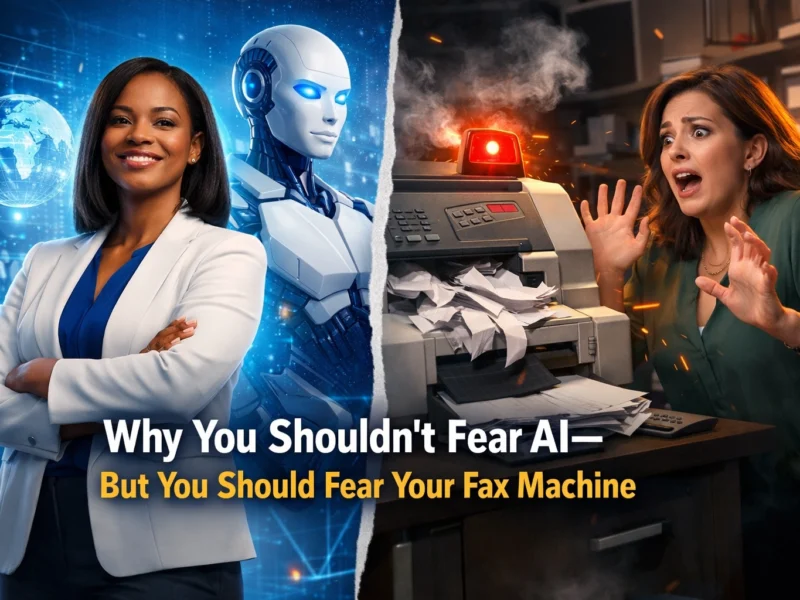
Let me ask you something: when's the last time you used a fax machine? If your answer is "recently," we need to talk. Because if you're still faxing documents in 2026, you're not just behind the times, you're actively hurting your workforce productivity and leadership performance.
I recently had the pleasure of sitting down with 13 News Now in Virginia to discuss AI's impact on jobs, and the conversation that followed was eye-opening. The question everyone's asking is: "Will AI take my job?" But here's the truth that most leaders aren't saying out loud: AI won't take your job. But someone who knows how to use AI? They might.
AI Is Not the Future. It's Right Now.
Let's clear something up right away. When people say "AI is the future," they're already wrong. AI is embedded in everything you do today. Every time you use Google, ask Siri a question, check your GPS, or withdraw cash from an ATM, you're using artificial intelligence.
The real question isn't whether AI is coming. It's whether you're going to lead your team into using it effectively, ethically, and strategically, or whether you're going to be the leader still using the corporate equivalent of a fax machine while your competitors sprint ahead.

Right now, there are two camps in corporate America: leaders who are banning AI entirely (spoiler alert: your employees are using it anyway), and leaders who are using it without any guardrails, compliance, or strategy. Both approaches are dangerous. What we need is change management, the kind of leadership development that helps you see the technology, understand the risks, and guide your people through it with confidence.
Enhancement, Not Replacement (But Here's the Catch)
Here's where I need you to really hear me: AI doesn't replace the human elements of compassion, empathy, and leadership skills. A bot can't manage a team. It can't read the room when someone's struggling. It can't have a difficult conversation with the kind of emotional intelligence that builds trust.
But, and this is a big but, AI absolutely enhances what you can do. Think about all the redundant, repetitive tasks eating up your day. Research that takes hours. Data entry that feels like drowning. Scheduling meetings across five time zones. These are AI's strengths. This is where the tool shines.
When you learn to use AI effectively, you free up your brain space for the work that actually matters: leading people, making strategic decisions, building relationships, and driving your organization forward. That's workforce productivity on steroids.

The uncomfortable truth? People who embrace this technology and learn to use it well are going to outperform, and yes, potentially replace: those who refuse to adapt. Not because AI is doing their job, but because they're doing their job better, faster, and more strategically.
The Fax Machine Test: Are You Leading in 2026 or 1996?
Let me paint you a picture. Imagine walking into a modern office and seeing someone hovering over a fax machine, waiting for a document to slowly transmit one page per minute. You'd think they were lost, right? It would be ludicrous.
Yet that's exactly what refusing to engage with AI looks like in 2026. You might not be using an actual fax machine, but if you're not leveraging the tools available to you, you're operating at fax machine speed in a high-speed internet world.
Here's what the research shows: healthcare organizations still using traditional fax machines are wasting 10 to 15 minutes per document on manual processing. That's not just inefficient: it's a drain on your team, your budget, and your competitive edge. Meanwhile, AI-powered document processing cuts that time down to 1 to 2 minutes. That's a 95% reduction in processing time.

The same principle applies across every industry. If you're doing manually what AI could do in seconds, you're burning time, money, and team morale. And in today's competitive landscape, that's a leadership performance issue you can't afford to ignore.
What Makes You Human Is What AI Can't Touch
Now, before you panic and think I'm suggesting we all become robots, let me be crystal clear: the most important parts of leadership cannot and will not be replaced by technology.
AI cannot have empathy. It can't read between the lines when an employee says "I'm fine" but clearly isn't. It can't celebrate a team win with genuine joy or sit with someone through a hard moment. These human elements: compassion, emotional intelligence, the ability to truly see and hear your people: are irreplaceable.
This is why leadership development in the age of AI isn't about becoming more tech-savvy (though that helps). It's about doubling down on the skills that make you human. It's about using AI to handle the mundane so you have more capacity for the meaningful.
The Ethics Conversation: How to Use AI Without Losing Your Soul (or Your Job)
Let's talk about the elephant in the room: ethical AI use. Because right now, we're in the Wild West. People are using AI to generate entire reports, presentations, and proposals without checking if the information is even true. Others are feeding sensitive company data into AI tools without realizing they've just exposed trade secrets to the entire internet.
Here's your ethical AI checklist:
First, never take AI's output at face value. AI doesn't "make mistakes" in the traditional sense: it generates responses based on patterns in data. But it can absolutely give you false information presented with complete confidence. Always verify. Always fact-check.
Second, give credit where it's due. If you used AI to research or draft something, say so. Transparency builds trust. Hiding your process erodes it.
Third, and this is critical: protect Personally Identifiable Information (PII) at all costs. The moment you input sensitive employee data, client information, or proprietary company details into an AI tool, you've potentially exposed it to the world. This isn't just an ethics issue: it's a legal one. Your company's reputation, your brand, and your job are all at risk.

In higher education, where I also work, we're seeing this play out in real-time. Students who use AI to write entire papers without checking sources or citing their process are failing. The same applies in business: leaders who use AI recklessly without guardrails are putting their organizations at serious risk.
Change Management: The Leadership Skill That Matters Most
If there's one takeaway from this entire conversation, it's this: change management is the leadership skill of our generation.
AI is change. It's transformation. And whether you like it or not, you're in the middle of it. The question is whether you're going to lead your team through it with clarity and confidence, or whether you're going to resist until you're left behind.
Great change management starts with honesty. Acknowledge that this is new, uncomfortable, and sometimes scary. Don't pretend you have all the answers. But commit to learning alongside your team. Start small. Ask questions like: What tasks are taking us the most time? What's repetitive? Where could we be more efficient?
Then, bring your team along. Show them how to use AI in ways that make their lives easier, not harder. Train them on ethical use. Set clear policies around what's acceptable and what's not. Create a culture where people feel safe experimenting with new tools without fear of punishment.
This is leadership development at its finest: guiding your people through uncertainty with a steady hand and a clear vision.

Lead Forward, Not Backward
AI isn't something to fear. It's a tool, just like your smartphone, your email, or your CRM. But like any tool, it requires skill, strategy, and intentionality to use well.
The leaders who will thrive in the next decade aren't the ones with the fanciest technology. They're the ones who blend human connection with smart systems. They're the ones who protect their people while pushing them to grow. They're the ones who aren't afraid of change: they're the ones leading it.
If you're ready to step into that kind of leadership, I've written an entire book to help you get there. Lead Like You Mean It is your playbook for leading with power, confidence, and authenticity in a world that's changing faster than ever. It's time to stop playing small. It's time to lead like you mean it.
#Lead Like You Mean It
 Flawless is the Enemy of Fast: Why Your Leaders Need an 'Agile' Mindset